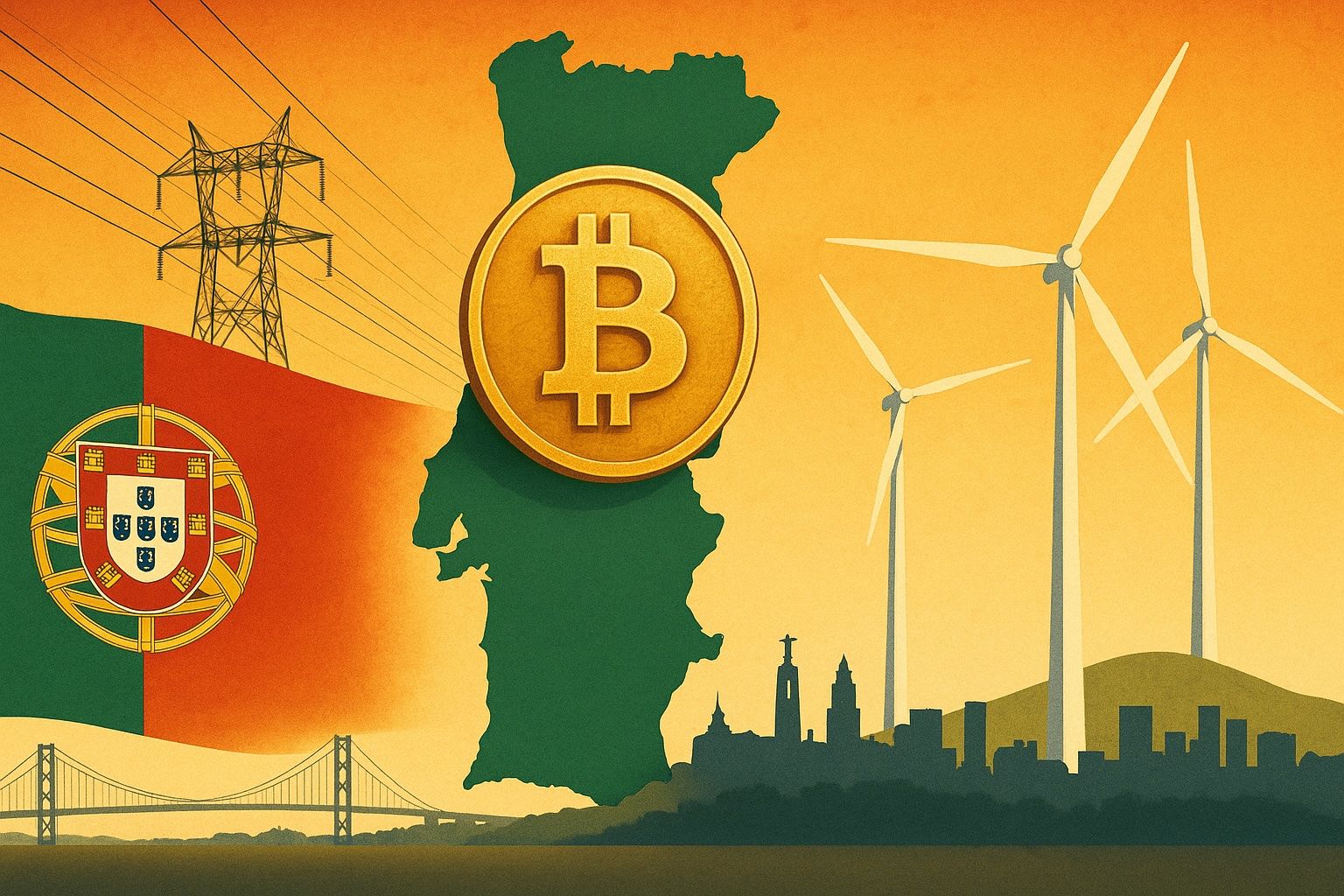
Portugal must accumulate Bitcoin before its allies and adversaries
Article written in collaboration with Henrique Corrêa da Silva
The projection of energy and power has always been essential to guaranteeing security, but throughout history it has implied destruction or death. Today, for the first time, we can transfer this projection into cyberspace, avoiding the use of violence. Bitcoin’s Proof-of-Work system transforms electricity, the most universal form of energy, into incorruptible digital property, which makes it possible to impose a real physical cost on adversaries in the digital domain.
Bitcoin, a monetary network that began as a peer-to-peer digital payment system, has become something much deeper: a new domain of warfare, a planet-scale computer, and a secure foundation for an infrastructure that offers digital sovereignty.
Countries that do not understand this change are blindly walking into a new geopolitical reality without realizing it. The front line of 21st-century warfare is no longer land, sea, air, or space, but cyberspace; and Bitcoin is its battlefield.
Thus, the first countries to create a strategic position and accumulate a greater share of this scarce digital territory will inherit asymmetric power and a lasting strategic advantage. The hesitant will become dependent on those who control commerce and property in the digital domain, and Portugal cannot be left behind.
Strength, territory, and the new domain of warfare
Over thousands of years, countries have fought for control over scarce physical resources: land, minerals, and energy. Each domain of warfare—land, sea, air, or space—has expanded human reach and redefined each nation’s sovereignty. The first nations to become proficient in each of these domains became world powers. This is how Portugal created the first truly global maritime empire five centuries ago.
Today, we are entering a new domain of warfare: cyberspace. Unlike physical domains, this one is made of information alone. Even so, in recent decades information has become humanity’s most valuable resource and the foundation of the global financial system, communication, and governance itself. The challenge is that information has no natural scarcity or physical constraint and, therefore, can be copied, censored, and forged at no cost, since bits of information are easy to produce. In fact, the absence of a physical cost associated with actions and movements in cyberspace has made it the most contested, exploitable, and easily abused domain on the planet.
Bitcoin changes the rules of the game. By embedding energy into digital information, Bitcoin restores physical scarcity and real consequences in cyberspace. Each block of information added to the blockchain is proof that energy was used computationally and that work was performed, which represents an immutable, unfalsifiable real signal that real effort was expended to alter Bitcoin’s universal ledger.
Through Proof-of-Work, any nation can project physical power into cyberspace in the same way it does with armies, navies, or air forces, but this time without kinetic violence.
The implications of this new paradigm are enormous: cyberspace now has terrain, which can be occupied, defended, and, more importantly, owned. Thus, Portugal must hold part of this battlefield terrain in order to position itself strategically for an even more digital future.
Bitcoin as strategic territory
What gold was over millennia in the age of great empires, Bitcoin is today in the age of digital networks: a form of property that is scarce, verifiable, and incorruptible, based on the laws of physics and mathematics and not on politics. But Bitcoin is more than digital gold. Bitcoin is a digital territory that expands through the application of energy and physical power.
The more energy that is applied to and absorbed by the network, the more valuable the network as a whole becomes. Each bitcoin represents a finite slice of this global energy-based territory. Owning bitcoin is equivalent to owning a plot of this planetary network that cannot be censored, invaded, or confiscated without an immense physical cost.
This makes Bitcoin not only a monetary asset, but also a strategic resource comparable to oil fields or semiconductor factories. The absolutely fixed and limited supply of 21 million bitcoins means that the first nations to join the network and adopt Bitcoin capture a permanent fraction of all the energy that this system will ever have. And as more countries, companies, and individuals join, the amount of energy that secures the network increases, which also increases the value of each bitcoin.
In geopolitical terms, this creates a first-mover advantage similar to the conquest of territory during the colonization of a continent. Once taken, that portion cannot be diluted or inflated. Therefore, the later a country acts to create a position, the smaller its share of sovereignty in the digital domain will be.
Thus, Portugal must recover its pioneering spirit of the Age of Discoveries and begin strategically mining and acquiring this asset that will undoubtedly redefine global geopolitics. The sooner it does so, the more influence Portugal will be able to project through cyberspace and the greater its national wealth will be.
The nature of physical power in cyberspace
The main innovation behind Bitcoin is not a digital currency or the blockchain. The true innovation is the conversion of real energy, measured in watts, into digital proofs of power (receipts), which can be stored and transmitted without intermediaries and without being censored. This process turns the global electrical grid into the motherboard of a planetary computer through which humanity can compete for control on equal footing, without needing to trust third parties.
Each proof-of-work in each block is energy applied in pursuit of consensus. The more energy a country contributes through the mining process, the greater its influence in ensuring the security and integrity of the network. Even so, this influence cannot be abused or turned into a weapon against others. In fact, that influence is constantly contested by others through open and voluntary competition.
Indeed, through the proof-of-work mechanism, countries can participate, in a non-lethal way, in a competition of power projection in cyberspace, where electricity replaces gunpowder and computation replaces artillery. The result is a balance of power based on the laws of physics and not ideology, creating a global architecture of deterrence immune to censorship and corruption.
Thus, holding bitcoin means owning a part of this network, and mining Bitcoin means participating in its defense. Together, these actions form a peaceful alliance based on energy, where all participants strengthen one another through competition.
The new arms race
All major military innovations have shaped the world order. The same is true for Bitcoin’s Proof-of-Work mechanism, which introduces a new form of power projection: electro-cyber warfare, where intelligent machines compete for control over scarce digital resources that use electricity as ammunition. This is not a recent idea. In fact, in the early 20th century, Nikola Tesla theorized precisely about this reality.
Unlike nuclear weapons, this competition does not cause destruction. The result of this “soft war” is not the ruin of nations,** but more capable electrical grids, cheaper renewable energy, and more robust cyber defenses**. In this context, Bitcoin mining is neither a loss nor an environmental harm, given that a substantial and growing share of mining is based on renewable energy and stranded energy.
Every watt consumed to perform proof-of-work strengthens countries’ positions in the global hierarchy of digital sovereignty. Nations that control more energy and computing power reserve for themselves a larger slice of this emerging planetary computer, while those that do not participate will depend on others to ensure the integrity of their digital property.
Unfortunately, critics of Bitcoin’s energy consumption fail to understand the purpose of energy as a tool. Energy is not just for comfort. In fact, it is the means by which humanity preserves order against chaos and entropy. If the Bitcoin network and the energy competition that emerges from it are capable of preventing and deterring wars, corruption, and digital or physical tyranny, while consuming a small fraction of global electricity, that energy is not wasted. In fact, it is the best possible use of energy. Each watt spent to secure and preserve the truth is a watt not spent on violence, destruction, and death.
The first nations to realize this will quietly transform their surplus energy into a weapon to achieve sovereignty in cyberspace. Those that can project watts into cyberspace most efficiently and cheaply will dominate the new geopolitical order.
With its renewable energy fleet, Portugal is well positioned to seize this opportunity. In fact, the country can use the surplus energy it produces daily to mine Bitcoin and actively accumulate the scarcest monetary asset that has ever existed.
Bitcoin as global defense infrastructure
Bitcoin functions as a distributed defense system, since miners are spread across all continents, connected through redundant Internet routes, and powered by diverse energy sources. No central authority can shut down the network, and destroying it would require destroying both the Internet and the global electrical grid.
By adopting Bitcoin, countries join an electro-cyber militia that defends an integral and incorruptible information record. Participation guarantees access to a security infrastructure that no nation alone can destroy. In fact, it is a collective defense system where each participant’s contribution makes everyone stronger.
This infrastructure offers a unique solution that protects against one of the greatest vulnerabilities of the 21st century: the transformation of global payment systems into weapons used to sanction other countries. Indeed, the exclusion of countries from payment systems such as SWIFT shows how control over payment and information channels can translate into geopolitical dominance.
Bitcoin neutralizes this threat and allows any country to send, receive, and custody financial information without needing oversight or permission from third parties. This guarantees freedom of action in cyberspace, something comparable to securing land, sea, or air routes.
Thus, a nation that does not participate in the Bitcoin network is exposed to financial coercion and denial-of-service cyberattacks. On the other hand, participation guarantees a seat at the new table of digital power, and Portugal must be there from the very beginning.
The advantage of arriving first
Bitcoin’s design incorporates a deep asymmetry. Its supply is limited (21 million units), but the network’s capacity and security can expand infinitely. This creates a paradox similar to Gabriel’s Horn: a finite volume with an infinite surface area; which means that the total number of bitcoins will never exceed 21 million, but the amount of energy each one represents can increase infinitely and grow without limit.
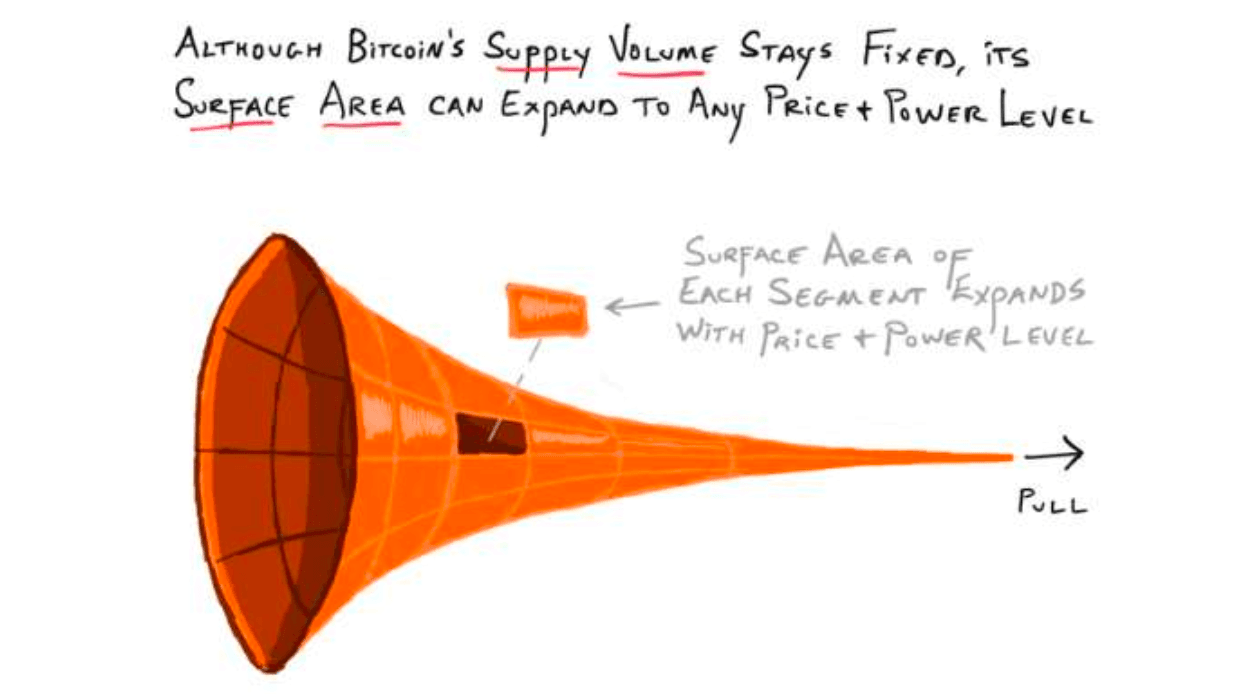
This has a critical strategic consequence. That is, the first countries to adopt Bitcoin will inherit the benefits of all the energy that is later allocated to the system. As more human capital is allocated to the Bitcoin network, the stronger it becomes and the more the value of each unit grows.
In other words, the holder of a single bitcoin (or fraction of a unit) gains an increasing claim on the world’s entire energy base, while those who come late must expend an ever-growing amount of energy to acquire a small fraction. This means that when most of the energy infrastructure is integrated with the Bitcoin network, the entry cost to acquire a position will be extremely high.
For Portugal, this means the window of opportunity is shrinking. Each year of inaction increases the entry cost and reduces the share of digital territory available to claim. The first nations to accumulate Bitcoin will acquire the base layer of security upon which future digital economies will be built.
Proof-of-Work vs Proof-of-Stake: Real power vs imaginary power
Much of the political elite still wrongly assumes that all “cryptocurrencies” are the same. They are not. In fact, Proof-of-Work and Proof-of-Stake systems are completely opposite both physically and politically.
Proof-of-Work, the consensus mechanism used by Bitcoin, keeps information secure through energy expenditure—a process that is objective, egalitarian, and constrained by the laws of thermodynamics. In this way, it is resistant to corruption.
Proof-of-Stake, used by networks such as Ethereum, on the other hand, keeps information secure through permissioned trust and abstract privilege. It merely recreates the same control structures that Proof-of-Work was designed to replace. Stake is an imaginary construct and has no physical cost, which means it can be secretly consolidated, censored, or reversed. It is only “decentralized” in name.
Countries like Portugal that want to maintain their sovereignty must understand this fundamental distinction. Proof-of-Work is proof of real power. Proof-of-Stake is proof of privilege. The former guarantees the security of property through the laws of physics, while the latter does so by political and hierarchical means. Choosing the wrong system is equivalent to outsourcing national security to an unaccountable elite.
Strategic deterrence and Mutual Preservation
In the Nuclear Age, deterrence was achieved through the threat of mutual destruction. In the digital age, deterrence can be achieved through mutual preservation. When countries mine and hold Bitcoin, they are actively contributing to the security of the network. The more each nation invests, the more secure the network becomes for everyone.
Adversaries competing for hash power strengthen each other, because each new participant effectively increases the cost of attack for all others. This is the first form of zero-trust cooperation in human history: rivals working together while competing against one another.
Undoubtedly, this dynamic transforms geopolitical conflict. Instead of an escalation of kinetic warfare leading to destruction, competition for control of digital territory produces stability. In fact, nations project power not to conquer one another, but to maintain access to a shared infrastructure that preserves the ownership and integrity of private property in the digital domain.
Thus, an equilibrium emerges that guarantees mutual preservation; a balance of power maintained through continuous and non-lethal competition in the cyber domain.
Bitcoin as a national security imperative
For Portugal, not adopting and accumulating Bitcoin is not a neutral choice. It is strategic negligence. Indeed, the first countries to adopt revolutionary new technologies have redefined the global geopolitical power game. With Bitcoin it will be no different.
Consider the implications if rival powers accumulate vast reserves of Bitcoin or come to dominate Bitcoin mining worldwide. These countries would hold a disproportionate share of the only incorruptible digital ledger, a large proportion of the global trade base, and the supreme reserve asset of the digital information age. Their economic influence would be felt in every transaction, contract, or piece of information secured by the Bitcoin network.
**Thus, nations that establish a position in Bitcoin now will capture perpetual sovereignty in cyberspace. **Accumulating Bitcoin today is equivalent to accumulating plots of land on the new digital frontier—land that cannot be invaded, taxed without consent, or destroyed. Just as in the Age of Discovery, when Portugal became the world’s greatest superpower, this is a once-in-history opportunity to redefine the balance of power.
Conclusion
Every era of history has its decisive terrain. In antiquity, it was fertile land. In the industrial age, it was coal and steel. In the nuclear age, it was uranium. In the information age, it is Bitcoin: a scarce asset, anchored in energy, capable of keeping the foundations of cyberspace secure.
Accumulating Bitcoin is safeguarding territory in a new domain of power projection. Ignoring Bitcoin is naively ceding territory to others.
History rewards those who recognize paradigm shifts early. Bitcoin marks humanity’s transition from kinetic warfare to electro-cyber warfare and from destructive deterrence to mutual and cooperative preservation. Portugal has a choice: compete to secure its position in this new digital territory while it is still accessible, or fall behind forever.
In the coming decades, geopolitical influence will also be measured in hash power and sovereign reserves of energy and digital capital. The countries that understand this early will lead the world. This is because, in the 21st century, the nation that commands the most watts will also command the truth.