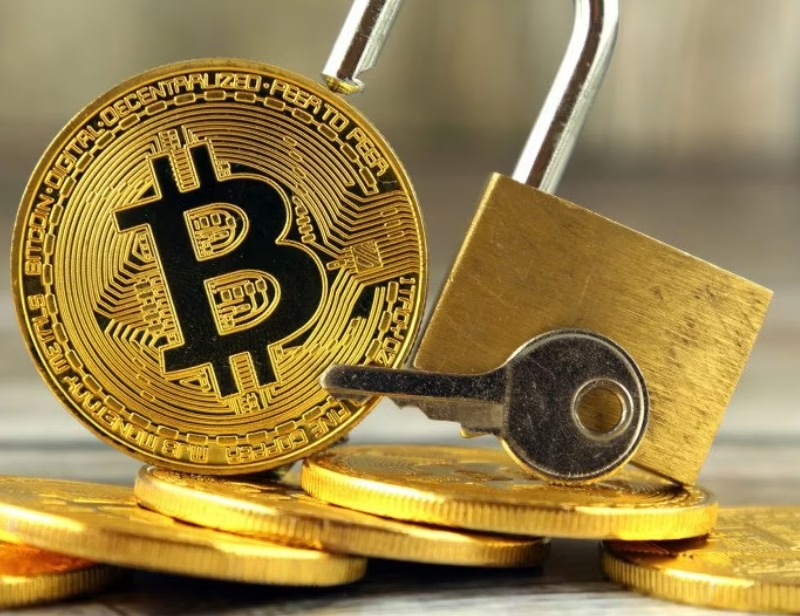
Bitcoin and Self-Custody
Bitcoin self-custody means holding Bitcoin without the need for banks or exchanges to store or secure access to the funds. Instead of relying on third parties, each person controls their own cryptographic private keys, which allow them to hold and access Bitcoin funds independently. Self-custody is typically managed through paper wallets, mobile wallets, or hardware wallets, which are responsible for keeping the private keys secure.
Although the technology, controls, and regulations surrounding custodial institutions are constantly being updated and improved, Bitcoin’s history is filled with custodial institutions and exchanges that have broken their users’ trust due to poor security practices or by maintaining fractional reserves of their users’ Bitcoin.
The basic principle of self-custody is: “Not your keys, not your coins.” By practicing self-custody, users eliminate counterparty, censorship, and confiscation risks. However, this form of custody comes with added responsibilities: secure backups, strong passwords, and careful key management. When done correctly, self-custody guarantees financial sovereignty, independence, and protection against failures of banks or exchanges.
Paper Wallets
A Bitcoin paper wallet is a physical document that contains the cryptographic keys needed to access and transfer Bitcoin funds. It typically includes a public address for receiving funds and a private key, often printed as a QR code for convenience. Since it is offline, a paper wallet is immune to online hacking, making it a form of cold storage. Still, there are risks. If lost, stolen, or damaged, the user can lose access to their bitcoins. Therefore, precautions should be taken — such as generating the keys securely, printing them on durable material, and storing them in multiple safe locations.
Hardware Wallet
One of the most common and simple forms of self-custody is using a hardware wallet with a single-signature setup. A hardware wallet is a small device whose main purpose is to store cryptographic private keys and provide secure access to Bitcoin funds. Typically, this device generates a sequence of 12 or 24 random words (known as a seed phrase), which should be written down on paper or engraved on metal and hidden in a secure location, separate from where the hardware wallet itself is stored. Coldcard, Blockstream Jade, and Trezor are examples of popular hardware wallets.
The seed phrase generated by the device is a human-readable backup that allows recovery of the cryptographic private key in case the device is lost or damaged. Thus, the device provides everyday access to funds and the ability to sign transactions, while the seed phrase ensures long-term key recovery capability.
Despite the popularity of this method and the fact that it allows private keys to be kept offline, relying on a single signature carries an increased risk of a single point of failure. For example, if the seed phrase is damaged or the device stolen, there is a possibility of losing access to the funds forever — something that becomes increasingly critical as the amount of Bitcoin associated with the wallet grows.
Multi-Signature Wallet
Another method of keeping Bitcoin funds secure is through a multi-signature wallet. This security technique requires multiple private keys to move funds. In this way, the funds remain secure even if one of the keys is lost or compromised. A multi-signature wallet can be configured in various ways, but the most common is “2 of 3,” where two of three signatures are required to move the funds.
It is possible to set up and maintain a multi-signature wallet independently using open-source software such as Sparrow Wallet, in combination with hardware wallets like those mentioned above. However, configuring such a wallet requires a high degree of technical competence.
There are several companies and projects that make creating, configuring, and maintaining a multi-signature wallet simpler and more user-friendly. Examples include Unchained, Bitkey, Casa, and Nunchuk. Some of these companies are 100% focused on Bitcoin, while others also support other cryptocurrencies. The best solution for each person varies according to their individual situation (amount of Bitcoin, technical knowledge, inheritance protocols, personal preferences regarding KYC, and their personal perception of the trade-off between usability, convenience, and security).
Regardless of the form of self-custody chosen, the most important thing is to ensure proper research is done to understand the risks and benefits of each configuration in particular. With great power comes great responsibility — and with self-custody, each individual is responsible for keeping their cryptographic private keys secure.