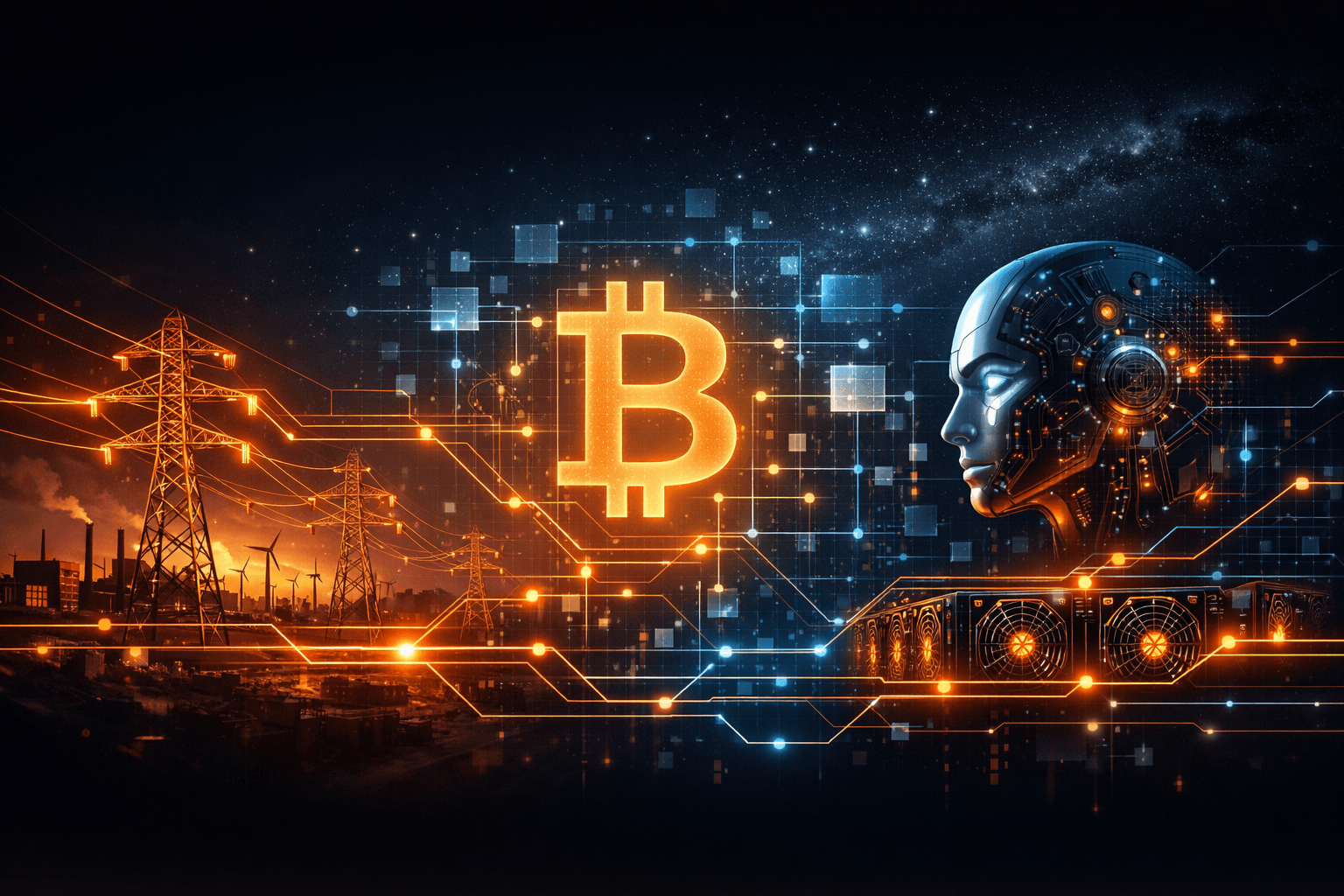
Bitcoin: Energy as the True Currency
Energy is nature’s medium of exchange, because everything that has value depends on energy to be created, moved, or defended. Food is nothing more than solar energy captured by plants and transferred along the food chain by other animals and human beings. Steel is ore reorganized in industrial furnaces using coal, gas, or electricity. A house is the end product of fuel burned in machines, electricity-powered tools, and human metabolic energy applied over months or years. Even personal and national freedom and security are, ultimately, the ability to project sufficient force—through various forms of energy—to prevent and deter others from taking lives or stealing private property. Behind every asset or piece of infrastructure lies energy expenditure.
In this way, it is possible to understand human civilization as the progressive capture, storage, and direction of energy toward the creation of structures such as roads, cities, networks, or institutions. Any monetary system that ignores this fundamental reality risks drifting away from the constraints that truly govern production and scarcity.
Fiat money and the drift away from physical reality
Fiat money largely breaks the link between money and energy, since new monetary units can be created at virtually zero cost. Governments and central banks can expand the money supply by billions of dollars by pressing a few keys on computers, and call that “wealth,” without simultaneously increasing the number of factories, land, or logistical capacity.
In the fiat system, the record of financial claims can expand far faster than the economy’s physical capacity. The result is a structural tension between nominal balance sheets and real resources.
The time value of money and of innovation becomes distorted: energy and production in the real world cannot scale at the same speed as new capital is created.
Bitcoin is money anchored in energy
Bitcoin was designed to restore a direct connection between money and energy. New units of Bitcoin are issued through proof-of-work, a verifiable process that requires real energy expenditure. Miners compete to add new blocks to the decentralized ledger (the blockchain) by performing computational calculations that consume electricity. The miner who finds a valid new block fastest is awarded new bitcoins and the corresponding transaction fees.
Therefore, each satoshi is the result of real joules being burned. Under current conditions, producing one bitcoin corresponds to millions of kilowatt-hours of electricity, given network difficulty and hardware efficiency. The energy used in this process is irreversible, and no authority can print more joules or redo the work already embedded in the blockchain.
In this way, each unit of Bitcoin represents energy credits already spent, recorded in an immutable public ledger. To update the ledger honestly, miners must pay the energy cost. And to attack the blockchain, an adversary must acquire more energy and run more hardware than the rest of the entire network. Fraud thus becomes physically prohibitive: rewriting blockchain history requires overpowering the cumulative proof-of-work—it is not enough to merely issue a command.
This structure gives Bitcoin the following properties:
- Absolute scarcity: The 21 million supply limit is enforced by protocol rules and economic incentives, not by decree. Changing the rules would require global coordination and would undermine the expectations that give the system value.
- High cost of censorship and attack: Gaining control of a majority of the network’s hash rate requires enormous capital and energy investment, making any attack unattractive compared to the alternative - honest participation in the network.
- A store of value anchored in energy: Each unit represents an energy cost that cannot be reversed. The enormous expense of reproducing that work acts as a defense against diluting Bitcoin units (creating more) or confiscation.
Thus, Bitcoin operates as a form of monetary energy storage: past work becomes crystallized into a scarce digital asset whose security is anchored in the laws of thermodynamics.
Monetizing stranded and unused energy
This link between Bitcoin and energy has very important implications for global electricity generation. Many of the cleanest and lowest-cost energy sources are located far from major urban centers, where demand is higher. In such cases, the viability of using that energy is limited by the high costs of the infrastructure required to transport electricity, such as transmission lines. As a result, a significant portion of generation potential remains underutilized, is wasted, or is never developed.
Bitcoin mining offers an alternative. Instead of extending the electrical grid to bring electricity to consumers, mining equipment—together with a satellite internet connection—can be moved to where energy is abundant and cheaper, converting that previously wasted or intermittent energy directly into Bitcoin. In this way, the economic value of that energy becomes location-independent. An internet connection is enough to broadcast transaction blocks to the network and for miners to receive payment. The value of energy is thus transported as information rather than as electrons through wires.
In this sense, Bitcoin functions as a form of digital energy, allowing the economic value of electricity to be stored and transferred as a monetary asset. Any electricity-generation process gains, in the Bitcoin network, a buyer of last resort. And as individuals, companies, and institutions continue to discover and adopt Bitcoin, the expectation of future appreciation also increases the profitability of future innovative electricity-generation projects.
On the other hand, this also reduces uncertainty when investing in electricity generation in geographically remote locations, because monetization is no longer constrained by local demand or grid access, and there is always the option of selling Bitcoin on the market. The result is an economic incentive for efficient energy production, particularly in locations where traditional demand is weak or infrastructure fails. Over time, this dynamic promotes cheaper and more abundant electricity, putting downward pressure on prices for everyone, while supporting decentralization and local economic progress.
Therefore, countries that have energy surplus and are not mining Bitcoin are leaving money on the table.
AI acceleration and the demand for a monetary anchor
Artificial Intelligence introduces a new layer of pressure on existing economic structures. This is not just another wave of innovation. AI will, most likely, compress margins, shorten product life cycles, and change competitive dynamics.
In this environment, individuals and companies will seek assets that are not affected by products, platforms, or companies— a monetary anchor that does not “speed up” with technology. Bitcoin is perfect for this role because it is not a company, platform, or product. Moreover, it does not depend on margins or new customers. Bitcoin is a protocol that sets rules and follows a predictable issuance schedule.
Bitcoin’s value proposition is not about new features, rapid iterations, or fear of a new version of itself. Bitcoin’s purpose is to serve as a neutral, energy-backed final settlement layer—not as an application competing with others. As AI destabilizes traditional hierarchies and compresses time horizons, Bitcoin’s rigidity becomes an advantage. Thus, Bitcoin’s relevance does not diminish with the growth of AI; rather, its role as a savings vehicle and final settlement layer becomes more relevant.
The connection between AI and Bitcoin happens through energy. AI rests on computing capacity, computing rests on electricity, and electricity is increasingly stored and monetized through channels that Bitcoin supports. As AI expands its footprint, demand grows for a neutral global settlement layer capable of coordinating economic activity in an environment that is more computationally intense.
By connecting monetary value directly to energy consumption and providing a global market to monetize energy, Bitcoin offers the monetary base that remains structurally stable as the AI-led economy accelerates and is transformed.
Protocols and long-term defense
Bitcoin’s strength comes from its ability to survive, not from rapid evolution, because over time it becomes more resilient, more distributed, and more integrated into the financial system without having to reinvent itself. Across multiple cycles, Bitcoin has demonstrated high durability. Even amid regulatory and technological changes, it continues to operate according to the same set of rules.
Very few digital systems show such long-term resistance, especially in an environment where AI is making traditional advantages more fragile at an ever-accelerating pace. In the future, Bitcoin may be the only thing on the planet that functions as a defensive moat as part of the digital economy, while other companies or products do not have the same kind of protection.
When large institutions recognize this reality, their concern will shift away from volatility or the risk associated with Bitcoin and toward the sufficiency of their exposure—namely whether they missed the opportunity to enter earlier or whether their Bitcoin positions are insufficient for the sustainability of their long-term financial strategy.
A monetary system aligned with energy and propelled by innovation
Fiat money expands credits in the banking system faster than economic growth and depends on the trust people place in that system. That trust can disappear if the system comes under stress. By contrast, Bitcoin ties money to energy and to a security mechanism that is deliberately costly and resistant to sudden changes.
This combination of an energy link and protocol stability positions Bitcoin as the best monetary base for a new era marked by computational acceleration and economic volatility. Bitcoin monetizes the global electrical grid, provides a neutral final settlement base, and gives people a digital asset that becomes more resistant over time through network effects.
In a world where AI can accelerate everything in the economy, the need becomes obvious for a foundation that remains governed by the predictable laws of physics. Bitcoin’s architecture, as a protocol grounded in energy consumption, establishes a monetary framework consistent with the physical principles of thermodynamics and with an economy increasingly driven by AI—whose expansion depends directly on energy availability.